Rattleman by George D. Shuman

Picture
This is a superb book. Not only does it have a great plot and a chilling serial killer but the effortless description of the Appalachian Mountains was outstanding. I was there, scrambling up those rocky hillsides, listening to the crack of the spruce and smelling the blood. 

It took a little time for me to fall into step with the two main characters, Sheriff Wayne and Judy, but the detailed depiction of the killer kept me enthralled. Once the book got into its stride I was hooked and read the whole thing in twenty four hours. This is one of the best book I have read this year. 

Rattleman on amazon


‘ALL CHARACTERS IN THIS NOVEL ARE ENTIRELY FICTITIOUS...’ 
Part One

Q: What’s in a name?

I had a fun conversation with my Mum yesterday.  She had done some family history research into her own ancestors and was bemused to discover that she had a seventeenth century relative called BARNABUS GOULDSMITH.  For some reason this tickled her pink.  She loved the sound of his name and spent twenty minutes persuading me to put Barnabus into my next novel.  To keep the peace and to avoid being disinherited, I finally agreed.  However, I may draw the line at her suggestion that I make him into a smuggler.

This made me wonder how many other authors find themselves under similar pressure to adjust their plots and characters for the amusement of their loved ones?  And more intriguingly, how do authors choose the names for their characters in the first place?

PictureNorth Carter Moor Farmhouse
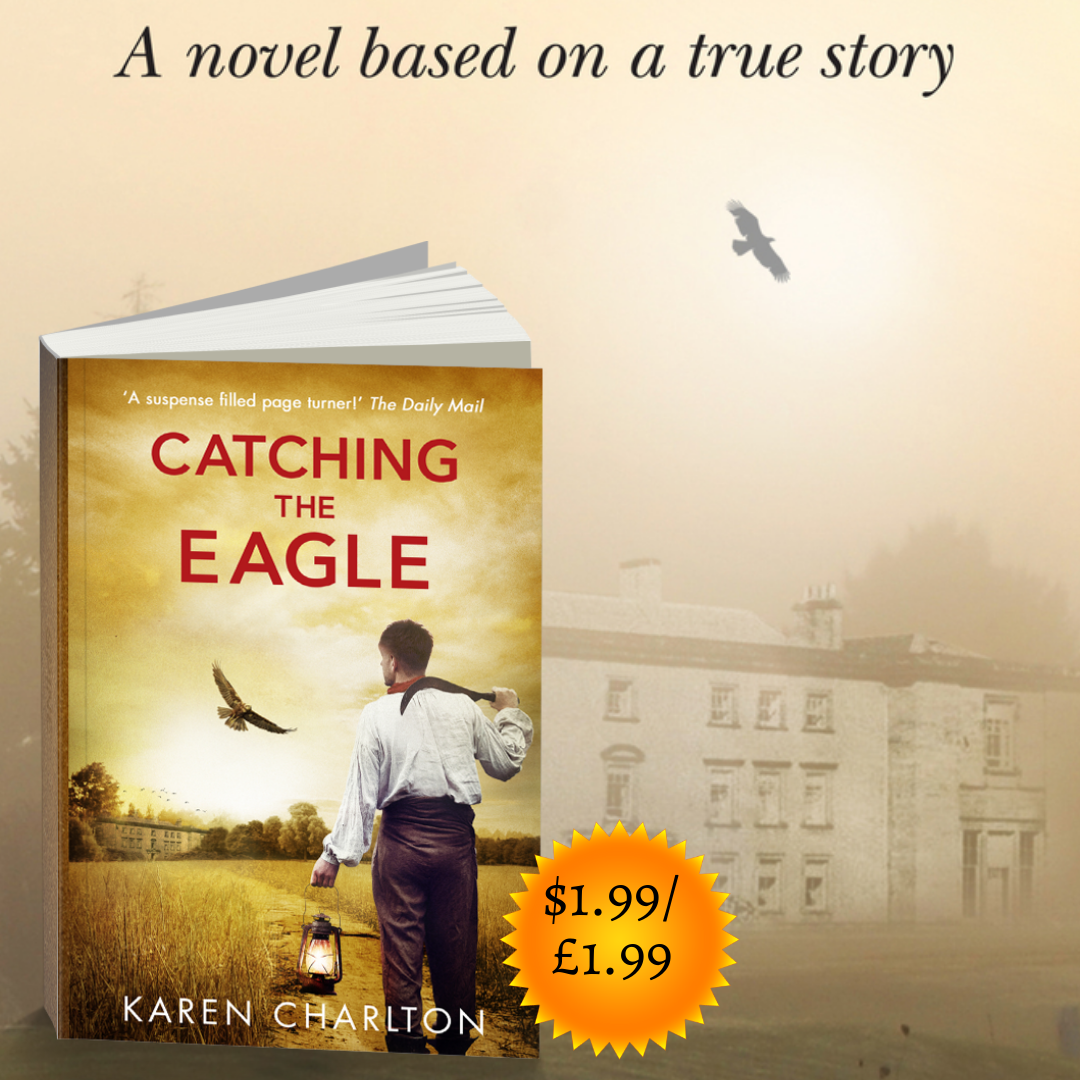
When I wrote Catching the Eagle the naming process should have been simple.  This novel was based on the true story of our criminal ancestor, Jamie Charlton.  Genealogical research had already revealed the real names of his family, the witnesses at his trial in 1812, the court officials and half the population of rural Ponteland.

But it quickly became obvious that I would have to make some adjustment to those names.  For a start, nearly everyone back in 1812 was called ‘John.’   This included Jamie’s father, son, brother, best friend, the man he robbed and the magistrate who charged him.  Obviously some of them had to go or be known as ‘Jack.’  (Or even Nathanial.)  This tradition of calling children after other family members had helped us trace our relatives back through the centuries and uncover Jamie’s sorry tale of injustice.  But to write a novel about three generations of the same family, all in the same farmhouse and all called either ‘John’ or ‘Ann’ would have confused the hell out of my readers. 


Picture
Then there was the problem of the sheer number of people our research had uncovered. They had big families back in the nineteenth century and ours was no exception.   A cast of thousands may have worked well in the bible but it rarely works in modern fiction. 

Fortunately, novelists can use artistic license.  In Catching the Eagle, I changed names, liberally handed out nicknames and killed off one character a couple of decades early. However, this process can still be dangerous in a novel based on a true story because someone somewhere is going to be unhappy that you have altered history.  I think I may have inadvertently offended a distant cousin in Australia when I changed the name of his 4 x great-grandmother from ‘Ann’ to ‘Mary.’


Picture
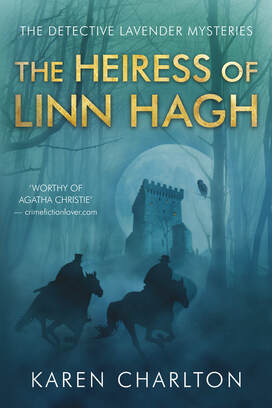
From the naming point of view, it was quite refreshing to sit down and write my second novel, The Missing Heiress.  Apart from Detective Stephen Lavender and a brief appearance by Magistrate Clennell, the rest of the characters were fictitious and I could call them what I wanted. I took a pragmatic approach.  I picked a different letter from the alphabet for each character, chose names indigenous to Northumberland, appropriate for the Regency era and tried to make sure that there was no repetition.  I often find it confusing if characters in novels have similar sounding names or if they begin with the same letter.   

However, when I called the younger brother of the missing heiress, ‘Matthew’, I never imagined the embarrassment this would later cause me.  Matthew was a very popular name in late 18th century England.  It is also the name of my own younger brother. (Yes, I think you can see where this is going.)  When I plotted the book I instinctively named Matthew Carnaby after my own brother and thought nothing more about it. In my head, this was a convenient – possibly temporary - arrangement which would help me remember who he was while I sorted out the rest of the details about him and the other characters.  

At the start of a novel, everything is fluid and full of potential. Minor characters like Matthew Carnaby are particularly sketchy; his personality and circumstances were vague.  He eventually became a sad and tragic figure, the victim of horrific abuse in his infancy which had left him mute and physically scarred.  He developed into one of my favourite characters and will probably appear in a later novel in the series, but somehow while I was writing the novel I completely forgot about the significance of his name.


Post-publication, my slip up came back to haunt me.  Mum was the first to contact me with feedback after Heiress was released.  Of course she loved the book (bless her) and was full of praise.  But at the end of the conversation she quietly asked me: 

'Why did you name the ‘idiot’ younger brother after our Matthew?' 
Ooops.  I didn’t see this one coming.  Cue a blustering and red-faced author.  I can honestly say that until that moment, I hadn’t realised the implications when I gave the Bellingham village idiot the same name as my sibling.

‘Our Matthew’ also read The Missing Heiress and he sent me a text:

Reading Heiress and loving it.  Just got to the bit were the idiot younger brother has the shit kicked out of him…
Picture
Ouch.  He noticed.  In fact, he’s mentioned it several times recently.  Matthew has made it clear that I’m not going to get away with this one lightly - innocent mistake or not.  I sense a lifetime of ribbing ahead. 

It is amazing what else those close to you read into your work.  In the same conversation, Mum also wanted to know why I had called the unsavoury Baxter Carnaby after my gentle, God-fearing uncle:  Howard Baxter.  I hadn’t.  In my mind, Baxter was just a strong, memorable name.  Memorable is vitally important in fiction.


PictureHappier times: My siblings and I
I will be more cautious in future when naming my characters but I’m not sure that it will help.  In my experience, authors face an uphill struggle against the boundless imaginations of their close family and friends.  Our nearest and dearest fly off on a tangent when they read our books.  They hear our voices as they read and automatically look out for connections – obscure or real - to the life we lead and the people we know.  Their spiralling tangents have no limits.

The last I heard, I am still in my parent’s Last Will and Testament (just) but I may have to avoid being alone with my brother in the same room for a while.  In the meantime, for penance, I am doing a little research about Kentish smugglers and sketching out the character of one Master Barnabus Gouldsmith...

Q: What’s in a name?  

A: Everything!


Bow Street Runners and Early British Detectives

Picture
Kirkley Hall, Ponteland
In 2005, we made two surprising discoveries while researching my husband’s ancestors.  We first learnt that he had a convicted felon, a Regency jail-bird, roosting in the branches of his family tree, called Jamie Charlton.  Then we found out that a Bow Street detective, Stephen Lavender, had been involved in the investigation which sent our Jamie to trial.

Naturally, our first priority was to find out more about our skeleton in the closet but we were also intrigued by Detective Lavender.  He was referred to as ‘a principal officer’ with the Bow Street magistrates’ court in London.  I had heard the phrase ‘Bow Street runner’ many times before but I had no idea that there were British detectives as early as 1809.  I had always assumed that detectives were created along with the rest of the police force by Sir Robert Peel in 1829.

Years of research at The National Archives in London and the Northumberland Records Office gradually disclosed that our Jamie had been convicted of stealing the rent money from the Northumbrian manor house, Kirkley Hall.  It was an audacious crime; over £1,157 had been taken from the estate office at the hall.  Our research also revealed that Nathanial Ogle, the wealthy owner of Kirkley Hall, had paid for Detective Lavender to come up from London to solve the case. 

To Ogle’s delight, Lavender recovered the bulk of the missing money.  It had been thrown back over the wall of the kitchen garden in a sack, and lay half-hidden by a currant bush for several days until the detective instigated a thorough search of the grounds.  Only £162 of coins remained outstanding.  This is not as surprising as it may seem. Most of the recovered money was paper banknotes which had only been in circulation for a few years; in 1809 mos
t British commoners did not understand or trust paper money.

Picture
Lavender also discovered that Jamie Charlton, a disgruntled ex-employee of Kirkley Hall, had been on a generous spending spree in the weeks after the robbery and his investigation focussed on him.  In May 1809, he had Jamie arrested and sent for trial at the August Assizes in Newcastle.  However, they released him after an initial hearing because there was no evidence to actually connect him to the crime.  At this point, Stephen Lavender went back to London, famous for retrieving most of the stolen rent money but unable to secure the conviction of his main suspect.

Jamie Charlton also went home but he was rearrested a year later.  This time the evidence came from Jamie’s former cell mate, William Taylerson, and the local magistrate instigated the arrest.  Taylerson claimed that when they shared a cell together in prison, Jamie Charlton had confessed to him that he had, indeed, committed the crime.  Taylerson was a horse thief, already sentenced to death. After a trial which lasted fourteen hours, a jury of local landowners and nobility found Jamie guilty in just five minutes.  They sentenced him to transportation, and granted Taylerson a full pardon. The whole thing smacked of a miscarriage of justice - even by the dodgy legal standards of the Regency.

The ideal plot for a historical novel had just landed in my lap and Catching the Eagle was born. It took two years to write this book, which was eventually published by Knox Robinson Publishers of Historical Fiction in December 2011.


Picture
Bow Street Magistrate's Court, London
According to my research, when the principal officers like Lavender went out to work on cases in other counties of Britain, they usually worked alone.  As a novelist, this presented me with an interesting dilemma.  Literary convention in any crime fiction usually requires that the detective has an assistant.  In the end, I decided to veer away from historical fact with Catching the Eagle and bow down to the literary convention; I gave Lavender an assistant, Constable Edward Woods.  Although they were only minor characters in this first novel, I thoroughly enjoyed creating Woods and Lavender and developing the rapport and humorous dialogue which erupted spontaneously between them. I felt that I had created a winning duo of crime fighters and I didn’t want to let them go.

Natural curiosity drew me towards their world.  I began to invest time, money and effort on investigating those early British detectives.  ‘A Certain Share of Low Cunning:  A history of the Bow Street Runners 1792 – 1839’ written by David J. Cox became the main source of my research. I discovered that back in 1809, Bow Street Magistrates’ court, was the thriving centre of policing in the crime-ridden capital of England.  Bow Street and the Old Bailey Criminal Court were the vibrant partners in London’s justice system.  

http://www. oldbaileyonline.org/ is ripe source of information and inspiration for any author interested in crime, criminals and early British detectives. This website documents the proceedings of the Old Bailey, between the years of 1674-1913 and contains details of 197,745 criminal trials held at London's central criminal court.  Stephen Lavender frequently appears on the stand as a police witness in these documents.

Number 4 Bow Street was where Sir Henry Fielding, novelist and magistrate, first persuaded the British government to establish a police force in 1747. This was in response to the growing call to find an effective means to tackle the increasing crime and disorder in the capital, where every fourth shop was a ‘gin house,’  a vast sex trade sprawled across hundreds of brothels and gangs of highwaymen and cut-throats terrorized the roads on the outskirts of London.  Fielding brought together eight reliable constables, who soon gained a reputation for honesty and efficiency in their pursuit of criminals and later came to be known as ‘the Bow Street Runners.’  But Fielding faced an uphill struggle against both organised crime in the capital, and the mistrust of the politicians who paid for his policemen.


Picture
George IV, The Prince Regent
In the late eighteenth century, the wealthy elite of Britain preferred to spend their money on personal security, rather than funding a communal police force. If you needed to track down a criminal there were plenty of ‘thief takers’ – an early form of bounty hunter – whom the rich could employ to drag a suspect into the dock.  There was huge resistance to the notion of a centralised police force because of the brutal excesses of the French police system across the Channel, under the revolutionary fanatic, Joseph Fouché.   Nevertheless, the crime fighting force started by Sir Henry Fielding expanded and gained national recognition.  

By 1809, the year of my novels, the number of police personnel had dramatically increased and a horse patrol had been established to bring some law and order to the crime-infested outlying areas. Principal officers were restyled ‘detectives’ and had various roles.  Apart from supporting their colleagues in the capital, they were often sent out to help magistrates in the provinces with difficult cases.  They took part in undercover work in periods of insurrection, for example, during the Luddite riots in the Midlands.  

The principal officers were a policing elite, famous throughout London, and the aristocracy loved them.  They did security work for the Bank of England and acted as bodyguards for Royalty, especially the Prince Regent.  They were the only policemen allowed into Buckingham House, the forerunner of the palace.  On occasions they were even sent abroad to help with crimes and criminals who had spilled out over our borders onto the continent.  

According to the records I have unearthed, Stephen Lavender spent a lot of his time working on difficult cases out in the provinces. Wealthy landowning citizens, like Nathanial Ogle of Kirkley Hall, could request the help of a principal officer.  Bow Street would charge them a hefty fee and the detectives could claim lucrative expenses on top of their salary. Many principal officers became very rich.


Picture
The arrest of Emmeline Pankhurst
However, the Bow Street officers were still regarded with mistrust by the general population and there were many allegations of police corruption – some of them genuine. In 1829, the government charged Sir Robert Peel with the task of creating a new national police force; a force which was properly funded and more accountable. Following this transition, Stephen Lavender became the highly-respected Deputy Chief Constable of Manchester. 

Bow Street itself remained a magistrates’ court until 2004.  During its two hundred and fifty year reign as Britain’s most famous police station, it has had both the famous, and the infamous, pass across its threshold.  From the legendary lover, Giacomo Casanova, to the murderer, Dr. Crippen, and the notorious East End gangsters, the Kray twins; from the famous mother and daughter suffragettes, Emmeline and Christabel Pankhurst to the brilliant, homosexual playwright, Oscar Wilde and more recently, the Chilean dictator , General Pinochet.


Picture
In that tense and frustrating period between the completion of my debut novel, Catching the Eagle, and securing a publisher for the book, the first seeds of a Regency whodunit began to germinate in my head. As far as I was concerned, there were only two policemen in England who could crack this mysterious case. I sat down at the computer and The Missing Heiress was born, with Detective Stephen Lavender and Constable Woods as the main characters.  Ultimately, Stephen Lavender was the man who charged our ancestor with stealing the Kirkley Hall rent money and placed him in the dock but I’ve never held that against him. He was the natural choice for the detective in my new novel. In my mind, he had grown from an interesting minor character to a fully-fledged and fascinating protagonist. The Missing Heiress flew off my keyboard like silk and I completed it in ten months.

In this first novel in a new series, the two policemen are called back to Northumberland, to investigate the mysterious disappearance of a beautiful young heiress from a locked bedchamber.  Convinced that this is a simple case of a young woman who has eloped with her lover, Lavender and Woods are later alarmed to discover a sinister world of madness, violence and secrets lurking behind the heavy oak door of the ancient pele tower at Linn Hagh.

The Missing Heiress was published by Knox Robinson Publishing on 6th December 2012.

(Article first published on Shots: Crime and Thriller eZine, December 2012)


THE MAGPIE - J.G. Harlond

Picture
The Magpie is the story of Leo Kazan and Davina Dymond, lovers separated by continents, time and social convention. Set in the tumultuous years between the two World Wars when revolution ripped Russia apart and nationalism and the Home Rule movement began to dismantle 400 years of the British Raj in India, it is a love story played out on an international stage. 

Leo is half Russian and half Indian, an orphan (or so he thinks) and a talented linguist. He is also a thief, attracted like a magpie to everything which glitters.  He becomes the protégé of Sir Lionel Pinchcoffin, the District Political Officer in Bombay. Pinchcoffin recognises Leo’s talents and turns him into a spy.  From an early age, Leo is immersed in the seedy world of international espionage and diamond smuggling.  He travels from India to Europe and Russia but the most meaningful time in his life are those few stolen days he spends with Davina in London.

The Magpie is a fascinating novel here and Leo is a very likeable/loveable rogue. The book is richly immersed in historical context and I can see, feel, hear and smell India and Spain.  It’s a fabulous piece of escapism for the reader, and a brilliant evocation of Colonial India, written with vigour and pace.  


TO THE GRAVE - STEVE ROBINSON

Picture
I have just finished reading ‘To the Grave’ and I loved it.  I think it is a better book than Robinson’s first novel ‘In the Blood ’– and THAT was pretty damned good. I don’t know whether it was because this second mystery was more recent (1940’s rather than early nineteenth century) or because it was a more personal story for the author, but I was completely hooked from start to finish and read it in two days. These novels have tremendous potential for a TV series.

Steve writes about Mena so tenderly and I was completely immersed in her story – to the point that I was horrified and saddened by what happened to her.

The mystery unfolded well with a good selection of red herrings which completely fooled me, and aspects of the book had a literary quality which reminded me of Ian McEwan’s ‘Atonement.’


I'm now looking forward to reading 'The Last Queen of England,' his third book in the series.


Adventures of a wandering author...

I rarely travel away these days and usually I’m not allowed out on my own (for reasons which will soon become obvious) but I have just returned from a short trip 'oop north' to see my friend, Babs, in deepest, darkest Northumberland and another friend, Jill, in Edinburgh.  

My journey to ‘the village with no bus’ in rural Coquetdale proved relatively uneventful.  I wound my way carefully down the remote wooded valleys, catching glimpses through the trees of the surrounding snow-topped hills which resembled fat iced buns, I followed the diversion signs to circumnavigate the landslip and managed to avoid the humungous pothole which rent the road in two. 

Picture
A kune kune pig
I always approach the junction where the petting farm spills out into the lane with extreme caution.  This time I merely had to stop to let a glossy-feathered cockerel strut across the road.  Yes, an entire pack of alpacas watched me over the crumbling stone wall and a couple of kune kune piglets snuffled in the muddy verge, but thankfully there was no sign of the wild goat herd and I didn’t hit anything with a pulse.   

Fortunately, nothing hit me either.  I was a little alarmed to see on the TV news that both the French and the British armies were involved in a major artillery bombardment exercise on the Otterburn ranges to coincide with my visit.  Thankfully, I can report that their missiles were all on target on Friday. However, the vast number of potholes which pepper those Northumbrian lanes suggest that this hasn’t always been the case.


Picture
Edinburgh in the snow
Unfortunately, I had a few problems later in Edinburgh when my sat nav repeatedly tried to take me down a road that was dug up to accommodate the expanding tram network.  Round and round the city centre I went – and kept coming back to the same spot. I eventually made it to Jill’s new flat (two hours late) but not before I had spent ten minutes at number 25 trying to persuade a man to let me in.  I later realised that I had misread the address and I should have been at number 27.  (Ooops.)

Jill and her partner spoilt me rotten and the magnificent city of Edinburgh gleamed with sunlight all day on Saturday. Apart from snapping off their toilet door handle, and mistaking Jill’s cat for a cushion and trying to prop it up on the back of the sofa, the weekend was relatively uneventful.  

And, yes…my next trip will be to specsavers… 


THE SACRED STONE by The Mediaeval Murderers

Picture
I thoroughly enjoyed reading ‘The Sacred Stone’ by the Mediaeval Murderers and found it a fascinating concept.  Five different historical novelists take the single idea of a strange stone, reputed to possess curative powers and – in the wrong hands – the power to summon demons, and they write about its progress through the Middle Ages.  Each author specialises in a different period of history and created a unique story around the mystique of the stone.  

A shard from an ancient Arctic meteorite, the sacred stone becomes legendary and the centre of controversy and crime. Theft, mayhem and murder follow it wherever it goes - and it goes a long way. From Greenland to Ireland, England and France the stone is handed from one distinctive character to another.  The five stories are rich in historical detail and take the reader on an enjoyable romp through six centuries. Every aspect of Mediaeval life is portrayed from the court of Edward III to the plight of the persecuted Jews in Norwich and the subjugation of the serfs in rural Devon. I was a little surprised that the final story took us out of the Mediaeval era and into the world of Shakespeare’s London, but as it contained the best description of a hangover I have ever read, I am not unduly bothered by this anomaly.

My only complaint is that the eBook contained no details about which author wrote which section, and it required detective work on my part to find out more about the writers of my favourite characters and stories. 


The Frustrations of Plotting Crime Fiction

Picture
Artwork by Bradley Wind
Successful crime fiction needs the fertile imagination of a confident author who can plot with the precision of an engineer, while juggling motive, clues, suspects and conflict like a circus clown.  It can be a frustrating process.

Crime fiction is essentially plot driven, which is rather annoying when you consider that it is primarily the strong character of the sleuths whom everyone remembers.  From Sherlock Holmes to Miss Marple, Rebus to Morse, this truth is self-evident.  No matter how well they are crafted, crime and thriller plots are easily forgotten.  Yet, crime fiction demands a compelling and credible plot to sweep the reader to a satisfying dénouement. 

Ideas for crime novels often come from seemingly unconnected events.  Recently, I viewed a BBC program Imagine, which followed best-selling writer Ian Rankin for six months.  I watched with fascination as he pulled out a battered manila folder bulging with press cuttings, scribbled notes and photographs.  These unconnected events were the source of his inspiration.

The two unconnected events which led to my own novel were my desire to set readers the challenge of a locked room mystery and the chance discovery of a family will from 1770.  Back then, ours was a dysfunctional family of ten half-siblings, two mothers and a mistrustful father.  This damning document revealed that favouritism, injustice and cruelty were rife in that farmhouse.   I began to imagine the burning resentment the will could ignite in the unbalanced mind of one of those spurned, and the murderous consequences which might follow.

A crime fiction writer who relies exclusively on real life murders for stimulation may find that their work becomes flat.  Stripped of their grisly horror, real murderers are remarkably predictable and murder is one of the easiest crimes for the police to solve.  Criminology reports throw up the same information time and time again.  Murder victims tend to know their killer.  A trio of three deadly motives, money, sex and revenge, generally lie behind the bloody act.  Statistically, serial killings by fiendish monsters are a relatively rare occurrence. Women usually murder in self-defence or after years of abuse by a husband or partner, whereas men tend to kill out of sexual jealousy or as a matter of honour.

This is where the fertile imagination of the crime fiction author needs to enrich the banal, avoid the stereotypes, switch genders and exaggerate.  Have the honour killings committed by a woman.  Let two Hannibal Lecters lurk in the dank alleys of your sleepy town.  Blur the edges of the motives.  Yes, a large inheritance is an excellent reason to kill someone but alone it can become predictable and one-dimensional.  Spice up your novel by allowing your sleuth to also uncover the murderer’s deep-seated psychological need to take revenge on the dead father who always favoured his youngest child.

Many, if not most, crime fiction writers fear readers will suss out their plot before the end of the book and be left disappointed.  This fear sometimes pressures authors into the fantastical, or they create a plot with more twists and turns than a staircase in a New York skyscraper in order to stay one step ahead of the reader.  These decisions can be a disaster.  Crime fiction writers need self-confidence and control.  Have faith in yourself and faith in the imagination of your readers.  If you’ve got doubts about your plot ask for the help of a couple of honest friends to tell you how your storyline has developed.

I was initiated into the genre of crime fiction in the bizarre world of Murder Mystery Weekends at a luxury hotel.  I wrote the scripts and directed the action but quickly learned that the guests’ imaginations were more twisted than my own. What seemed obvious to me, sent them spiralling off on a tangent.  I didn’t need to create red-herrings; they went fishing and happily netted plenty for themselves.  This experience gave me confidence.  When I wrote The Missing Heiress, I felt comfortable drip feeding clues into my story, knowing that my readers would not always spot them or understand their significance.  I wrote the book I wanted to write – and so should you.

Crime fiction writers also need supreme organisational skills and discipline.  The first step is to strip the story down to its bare bones and pin point where the conflict lies.  Make notes and place these sparse details onto a timeline or blank calendar which covers the timespan of your novel.  This helps you keep track of everything - especially the suspects.  Insert subtle clues into the plot and check your plan for pace, flow and balance.  Is your sleuth’s investigation a frenzy of activity on some days, while not much happens on others?  Does the conflict build gradually towards the climax of your book?

In its initial stages any novel is fluid and gradually evolves. Nothing is sacred, and authors can reinvent and reject until they settle on something that feels right and continues to feel right.  But as criminal investigations intensify one wrongly placed incident can throw the whole thing off track.

Half way through writing The Missing Heiress, I hit a wall. I just couldn’t see the ‘big picture’ of my novel on the computer screen.  So I grabbed the family noticeboard from the kitchen and divided it up into days.   I scribbled down the scenes of my novel onto post-it notes and pinned them into the cork.  It worked.  I now had a physical representation of how my story would unfold and could shuffle everything around with ease until balance and pace were restored.  On top of this, I had the added satisfaction of watching the post-it notes vanish as my novel crept towards the finish line. 

I have since learnt that Apple Mac have devised an ingenious computer program called Scrivener which provides a digital representation of a cork noticeboard. No doubt, it reduces the frustration of some authors busy plotting crime fiction.  However, I wonder if it can mimic the kinaesthetic satisfaction I experienced when I ripped down those final post-it notes, rolled them into a ball and hurled them into the bin? 


This article was first printed in The View from Here magazine on December 3rd, 2012.


'The Chosen Man' by J. G Harlond

Picture
'The Chosen Man' is an ambitious book which takes 17th century characters - from four different European countries - and successfully weaves their lives into a tapestry of political and religious intrigue and drama. 'The Chosen Man' has everything: shipwrecks; kidnap; piracy and romance - all set against the well-researched background of the first Stock Market crash in history. 


Once the characters had stopped travelling and settled down into their allotted roles, I loved it. Harlond brilliantly evokes both the buzzing commercial excitement and culture of the Dutch capital - and the gentle beauty and slow rhythm of a remote Cornish baronial estate. Yet menace lurks beneath the surface even in this rural idyll. I cared deeply about all the characters and the sinister undertones of both locations were well-sustained, ensuring I came back to the book quickly to check they all survived.

Harlond is also ambitious in the theme of romance. Never mind a love-triangle, this was a love quartet. Alina's dilemma kept us on our toes right until the last page. Which one of those three distinctive male characters will the independent Alina choose? Her gentle, aristocratic, yet sickly husband? Alonso, the attractive, self-made fellow Spaniard who has always loved her? Or Ludo? Ludo the Italian pirate; Ludo the con man. The bad-boy who lives by his wits, manipulates the Dutch and turns the European balance of power on its head, while side-stepping assassination attempts like we would dodge traffic.

A satisfying ending which demands a sequel.


'The Chosen Man' on amazon


The View from Here online literary magazine has published my article on 'The Frustrations of Plotting Crime Fiction.'

If you are interested in writing crime fiction, or who just wants to know how I wrote The Missing Heiress then please feel free to check it out... oh, and please leave a comment on the page.


The View From Here Magazine